'Gooners' is the wrong word: what the cosmetics market actually says about players
The internet has a sneer for people who love their characters. The data says they are the mainstream.
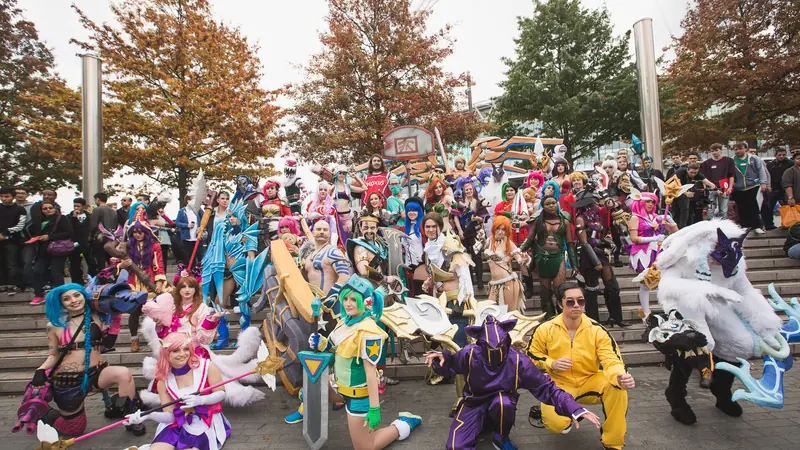
Header image: Photo: Rose Abrams, CC BY 4.0, via Wikimedia Commons.
There is a word going round for people who buy skins of attractive characters and admit to feelings about them: "gooner". It is used mockingly, sometimes worn as a joke by its targets. We think it is the wrong word, and we have a stake in saying so. We make Companion by AI Exodus, an AI voice companion that reads your screen with local OCR and talks back in the first person as the character you are playing, in World of Warcraft, Fortnite and AION 2. We sell that voice as a flat subscription. We sell no skins, items or characters, we have no romance personas, and we call our users players, nothing else.
Where the word comes from
The root is sexual, and that is the whole problem with borrowing it. Gooning, in Wikipedia's account, is "a sexual practice and subculture associated with extreme edging to the point of achieving a euphoric state (sometimes called a 'goon state')". It dates from the early 2000s, "possibly sprouting from 4chan", reached Urban Dictionary in 2005 and was shaped in the late 2000s by pornography-addiction communities on Tumblr. Google searches spiked in 2023; on TikTok, Gen Z and Gen Alpha broadened the definition "to include elevated excitement of any kind"; and in 2025 the adult platform Clips4Sale named gooning its "2026 Fetish of the Year", citing a "151% increase in sales for gooning content since 2023". From around 2023 the label is reported to have spread to games with heavy fan service and to players who buy skins of attractive characters. Aimed at a player, then, "gooner" does not describe a purchase; it accuses. We will not apply it to anyone who uses our product.
The older word for the same feeling
Anime fandom got there first with less contempt. "Waifu", a loanword from the English "wife", is first documented in the 2002 anime Azumanga Daioh and means a fictional female character toward whom one feels romantic or sexual attraction; "husbando" is the counterpart. A 2025 study in Psychology of Popular Media reported that approximately 38% of anime fans said they had a waifu or husbando, describing it as "a form of parasocial relationship where individuals develop genuine emotional attachments to fictional characters", and noting that the stigma some feel largely overlaps with prejudice against anime fans. The feeling is common; the sneer is inherited.
The mainstream, in money
The spending is not a fringe. Fortnite Battle Royale, funded entirely by cosmetics that change nothing in play, passed $9 billion in total revenue by the end of 2020 and 350 million registered players by May 2020. Genshin Impact, where players spend to obtain a character rather than a costume, reached $6.3 billion by its fourth anniversary in September 2024, averaging about $1.6 billion a year on mobile stores. Roblox Corporation reported $3.60 billion in 2024 revenue on an economy of user-made avatar items. Valve was estimated to have earned $1 billion in 2023 from Counter-Strike case keys and trade commission. Estimates differ by method and the biggest sellers are private, so we give no market total; but a habit shared by hundreds of millions is not a subculture.
Who they are
The people are not who the word implies. Wizards of the Coast's 2019 Dungeons & Dragons figures were 39% female, 61% male and 40% Gen Z, on a base the company put at 12 to 15 million North American players in 2017. Character.ai's 3.5 million daily visitors in January 2024 were "the vast majority of them 16 to 30 years old". Cosplay is its visible creative face, with weeks of work reported per outfit, alongside fan art, original characters and fan fiction. Psychology treats the underlying attachment as ordinary: imaginary companions are "a normative part of childhood and even adulthood".
What the science says instead
Lewis, Weber and Bowman titled their 2008 paper "They May Be Pixels, But They're MY Pixels" and built a scale for character attachment from identification, suspension of disbelief, responsibility and control. Klimmt, Hefner and Vorderer (Communication Theory, 2009) called the game experience "true" identification: self-perception temporarily merges with the character. Przybylski and colleagues (Psychological Science, 2012) found games "most intrinsically motivating when players' in-game experiences aligned with their ideal-self conceptions". Marder and colleagues (Computers in Human Behavior, 2019) asked why League of Legends players buy non-functional items; the reported drivers were looks, social distinction and identification with the character. Yee and Bailenson's Proteus effect (2007) adds that avatar appearance nudges the user's own behaviour, a small but consistent effect across 46 studies. Nothing here is a fetish. It is identity.
Where the criticism is fair
None of that excuses the industry that sells to the feeling. Gacha and loot boxes have drawn regulation: Japan is reported to have banned "kompu gacha" in 2012, Belgium to have moved against loot boxes in 2018 and the UK to have adopted voluntary principles in 2023. Bundles reported to be priced in the hundreds of dollars, such as the 2024 Faker Hall of Legends set, drew a backlash for a reason. Heavy "whale" spending is real, and the Counter-Strike market's estimated loss of $2 to $3 billion, roughly 28%, within days of an October 2025 update shows how fragile cosmetic "value" is. Attachment can also be exploited. Sewell Setzer III, 14, died in February 2024 after months of an emotional relationship with a Character.ai chatbot; his mother's October 2024 suit alleged missing safeguards and addictive design, and the company barred under-18s from open-ended chat from 25 November 2025. The fair criticism is of design that farms attachment, not of the people who feel it.
Our bit
We build for the attachment and refuse to sell it back. Our commitments: we will voice the character you already chose and never sell you a character or an item; our price is a flat subscription for the voice, unmoved by what a skin is worth; the persona is game commentary, not a partner, so there are no romance personas and no sexual content; it speaks on game events, respects your chattiness setting and never touches the controls; and we will not label our users. Outfit names and likenesses belong to the publishers. What is yours is the feeling, and it is not a punchline.
Caveats
- The gaming usage of "gooner" and the regulatory timeline are reported, not verified from primary texts.
- We quote no figure for the Faker bundle's charity pledge, Epic's court-disclosed revenue or the share of players who roleplay.
- The 38% figure is from one 2025 study, via Wikipedia.
- Wikipedia: Gooning en.wikipedia.org
- Wikipedia: Waifu en.wikipedia.org
- Wikipedia: Fortnite Battle Royale en.wikipedia.org
- Wikipedia: Genshin Impact en.wikipedia.org
- Wikipedia: Roblox Corporation en.wikipedia.org
- Wikipedia: Skin gambling en.wikipedia.org
- Wikipedia: Wizards of the Coast en.wikipedia.org
- Wikipedia: Character.ai en.wikipedia.org
- Wikipedia: Imaginary friend en.wikipedia.org
- Lewis, Weber and Bowman 2008, They May Be Pixels, But They're MY Pixels, CyberPsychology and Behavior doi.org
- Klimmt, Hefner and Vorderer 2009, The Video Game Experience as True Identification, Communication Theory doi.org
- Przybylski et al. 2012, The Ideal Self at Play, Psychological Science doi.org
- Marder et al. 2019, The Avatar's new clothes, Computers in Human Behavior doi.org
- Yee and Bailenson 2007, The Proteus Effect, Human Communication Research doi.org
Written by the Companion team in our own words. Facts, figures and quotes belong to their sources; prices and dates are as of 24 Sep 2026 and can change. We build a screen-reading voice companion ourselves, so read our opinions as a competitor's.