Why you love your skin: the science and the billions behind character attachment
Players spend real money on things that change nothing but how they look. Psychology says that is not irrational.
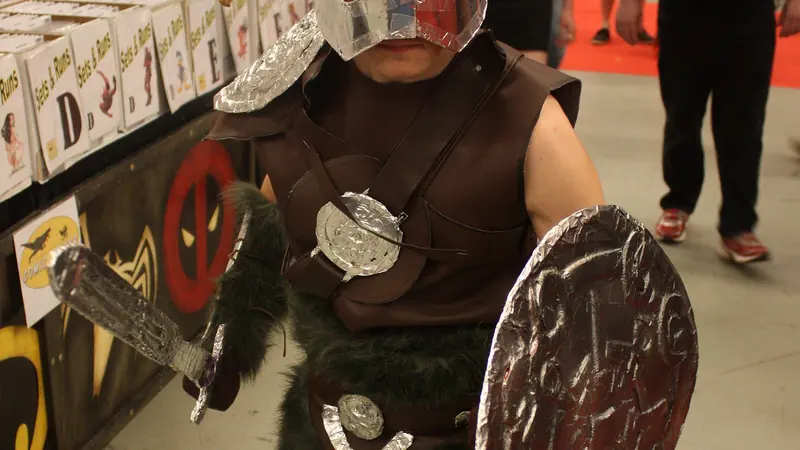
Header image: Photo: Bruce Liu, CC BY-SA 3.0, via Wikimedia Commons.
Players spend real money on things that change nothing but how they look, and a company that lives next to that attachment should say so at the top. We make Companion by AI Exodus, an AI voice companion that reads your screen with local OCR and talks back in the first person as the character you are playing, in World of Warcraft, Fortnite and AION 2. In Fortnite, the character is the outfit you have equipped. We sell the voice as a flat subscription. We sell no skins, items or characters, and this article is about why people buy those from others.
The billions
Fortnite Battle Royale is funded entirely by cosmetics: outfits, emotes and the Battle Pass, bought with V-Bucks, and nothing in the Item Shop affects gameplay. Wikipedia's account, citing the analyst SuperData, puts 2018 revenue at $2.4 billion, "the highest annual revenue for a free-to-play title", falling 25% to $1.8 billion in 2019, with total revenue past $9 billion by the end of 2020 and 350 million registered players by May 2020. Figures attributed to Epic itself, disclosed during Epic Games v. Apple (trial 3 to 24 May 2021, ruling 10 September 2021), were reported to be well above the analyst estimates; we have not verified them and do not repeat them. Epic does not publish Item Shop revenue for 2024 to 2026, so we do not guess at it.
The table carries the rest: Genshin Impact sells the character itself through gacha pulls rather than a costume; Counter-Strike skins are weapon cosmetics, not avatars, but show what people pay for pure status; Roblox's avatar items are made by its own users.
| Game | What is sold | Verified figure | Source |
|---|---|---|---|
| Fortnite Battle Royale | Outfits, emotes and the Battle Pass, bought with V-Bucks; nothing affects gameplay | $2.4bn in 2018 (SuperData estimate); total past $9bn by end of 2020; 350m registered players by May 2020 | Wikipedia: Fortnite Battle Royale |
| Genshin Impact | The characters themselves, obtained through gacha pulls | $6.3bn total revenue by the fourth anniversary (Sept 2024); about $1.6bn a year on App Store and Google Play | Wikipedia: Genshin Impact |
| Counter-Strike (Valve) | Weapon-skin case keys and commission on player-to-player trades | Estimated $1bn earned by Valve in 2023; one skin sold for more than $400,000 (April 2023) | Wikipedia: Skin gambling |
| Counter-Strike (player market) | Skins traded between players | Lost an estimated $2–3bn in value, roughly 28% of the market, within days of an October 2025 update | Wikipedia: Skin gambling |
| Roblox | User-made avatar items (avatar spend not broken out) | Company revenue $3.60bn in 2024; net loss $935m | Wikipedia: Roblox Corporation |
Why we give no single market figure
Headlines that put one number on "the cosmetics market" hide five disagreements: what is counted (skins alone, all microtransactions, or passes too), which panel is used (mobile trackers miss PC and console), gross or net of platform cuts, annual spend or the notional value of a secondary market, and the privacy of the largest sellers, Epic, HoYoverse and Riot. The gap between SuperData's Fortnite estimate and the figures reported from Epic's court disclosures shows how much a panel can miss. Treat any single number as a floor.
"They may be pixels, but they're MY pixels"
That is the title of a 2008 paper by Lewis, Weber and Bowman in CyberPsychology & Behavior, which built a scale for character attachment in role-playing games from identification, suspension of disbelief, responsibility for the character, and control. A year later Klimmt, Hefner and Vorderer, in Communication Theory, described the game experience as "true" identification: players temporarily merge their self-perception with the character rather than watching it from outside. Van Looy and colleagues validated a scale for this in online games in Media Psychology (2012), separating avatar attachment from group and game attachment. The bond is measurable, and it forms before anyone sells anything.
The ideal self
Przybylski, Weinstein, Murayama, Lynch and Ryan reported in Psychological Science (2012) that games are "most intrinsically motivating when players' in-game experiences aligned with their ideal-self conceptions", and that "high immersion and larger gaps between actual and ideal selves strengthened the connection". Ducheneaut, Wen, Yee and Wadley surveyed avatar personalisation across World of Warcraft, Second Life and Maple Story for CHI 2009; the reported finding is that most people build an idealised self, and time spent customising tracks attachment. Marder and colleagues asked in Computers in Human Behavior (2019) why players buy non-functional items in free-to-play games, with a League of Legends sample; the reported answer is looks, standing out socially, and identification with the character.
Does the skin make you play better?
Players say so. We know of no peer-reviewed study measuring skins against performance, so nobody has shown that a skin raises your kill-death ratio. The closest evidence is the Proteus effect, named by Yee and Bailenson in Human Communication Research (2007): a person's behaviour in a virtual world changes with the characteristics of their avatar, and a 2009 follow-up found the effect carrying into offline interaction. A meta-analysis of 46 studies by Ratan and colleagues found "a small-but-approaching-medium effect size" that is "relatively consistent (between 0.22 and 0.26)" and "reliable and sizable relative to other digital media effects". A confident-looking avatar nudges behaviour a little. That is all the science supports.
What this means for a voice that speaks as your character
Three things follow: the bond exists before we arrive; it is strongest where the player chose and customised the character; and speaking as that character can shift behaviour a little, which is a feature and a responsibility at once. Our commitments follow. We will voice the character you picked, never a generic mascot. We will keep the persona encouraging and never shaming. We will speak on game events, respect your chattiness setting and never touch the controls. We will ship no romance personas. And we will never sell the character or any item: outfit names and likenesses belong to the game's publisher, and what we sell is a subscription for the voice. When cosmetic "value" can lose 28% in days, we would rather our price not rest on it.
Caveats
- The Proteus effect is about behaviour, not results. No study shows skins improve measured performance.
- Estimates for the same title differ widely by method; we quote sources, not a market total.
- Riot named Faker the inaugural inductee of its Hall of Legends on 22 May 2024; the accompanying bundle was reported to cost several hundred US dollars and to include a charity pledge, whose total is unverified, so we quote none.
- Wikipedia: Fortnite Battle Royale en.wikipedia.org
- Wikipedia: Epic Games v. Apple en.wikipedia.org
- Wikipedia: Genshin Impact en.wikipedia.org
- Wikipedia: Skin gambling en.wikipedia.org
- Wikipedia: Roblox Corporation en.wikipedia.org
- Wikipedia: Faker (gamer) en.wikipedia.org
- Wikipedia: Proteus effect en.wikipedia.org
- Yee and Bailenson 2007, The Proteus Effect, Human Communication Research doi.org
- Klimmt, Hefner and Vorderer 2009, The Video Game Experience as True Identification, Communication Theory doi.org
- Van Looy et al. 2012, Player Identification in Online Games, Media Psychology doi.org
- Przybylski et al. 2012, The Ideal Self at Play, Psychological Science doi.org
- Lewis, Weber and Bowman 2008, They May Be Pixels, But They're MY Pixels, CyberPsychology and Behavior doi.org
- Ducheneaut et al. 2009, Body and mind: avatar personalization in three virtual worlds, CHI '09 doi.org
- Marder et al. 2019, The Avatar's new clothes, Computers in Human Behavior doi.org
Written by the Companion team in our own words. Facts, figures and quotes belong to their sources; prices and dates are as of 24 Sep 2026 and can change. We build a screen-reading voice companion ourselves, so read our opinions as a competitor's.